
Researchers have systematically analyzed the risks associated with LLM use in medicine. Their review article has now been published in Nature.
Read more
Many emerging medical technologies rely on seamless integration between biological systems and electronics. This requires materials that are soft, electrically conductive, and biologically active – properties that have been difficult to combine in a single system. Research teams led by Prof. Dr. Ivan Minev (TUD/EKFZ, Leibniz IPFDD) and by Dr. Christoph Tondera (Leibniz IPFDD and CRTD at TUD) have now developed such a material. The bioinspired hydrogel combines electrical and biochemical signal control for the first time. It binds signaling factors that stimulate cell growth and can release them on demand using electrical stimulation. It also functions as a sensor, capable of measuring biological parameters such as oxygen levels. This approach opens new possibilities for medical devices and implants, for example in the treatment of nervous system damages. The results were published in Advanced Materials.
Teuku Fawzul Akbar, Carlos Alejandro Jimenez-Rodriguez, Railia Biktimirova, Ilka Hermes, Thomas Kurth, My Duyen Pham, Mikhail V. Tsurkan, Jens Friedrichs, Francis L. C. Morgan, Hans Kleemann, Olga Guskova, Uwe Freudenberg, Peter Fratzl, Carsten Werner, Christoph Tondera, Ivan R. Minev: Conductive Hydrogels for Exogenous Sensing and Cell Fate Control; Advanced Materials, 2026.
DOI: 10.1002/adma.72866
For implants to be well tolerated by the body, their mechanical properties must match those of the surrounding tissue. In the nervous system in particular, this means that materials should be soft, flexible, and electrically conductive. Inspired by the natural cellular environment – the extracellular matrix (ECM) – the researchers developed a water-based material (hydrogel) that mimics key properties of the ECM while remaining electrically active. One component of the ECM is glycosaminoglycans, long-chain, highly negatively charged sugar molecules. These were combined with star-shaped polyethylene glycol (starPEG) to form a three-dimensional network capable of retaining water and other substances. The researchers then incorporated the semiconducting organic polymer PEDOT into this bioinspired hydrogel. The result is a new material (PEDOT:sGAGh) with promising properties for applications at the interface of biomedicine and electronics.
Beyond controlled release, the material can also function as a sensor. The team demonstrated this by measuring oxygen levels. In a biohybrid circuit, a drop in oxygen triggered an electrical signal that in turn initiated the release of a growth factor. This subsequently promoted the growth of nerve cells in cell culture. “Our material is the first to combine the soft properties of biological tissues with their natural modes of communication: signaling via biomolecules and electrical impulses. This represents an important step toward new biomedical devices and implants,” says Dr. Christoph Tondera, group leader from the Leibniz Institute of Polymer Research Dresden and the Center for Regenerative Therapies Dresden at TUD.
The hydrogel translates a principle from biology into technology by linking biochemical signaling with electrical control. In the future, the material could be used in electrode coatings or bioelectronic components for medical applications. In the long term, the technology may help improve brain-machine-interfaces. One potential application is brain implants that not only record or stimulate signals but combine both functions. This could improve treatment options for patients with conditions such as epilepsy or Parkinson’s disease. “As a next step, we will investigate the long-term stability, performance, and biocompatibility of the material. Our goal is to develop a prototype and evaluate it under clinically relevant conditions,” says Prof. Ivan Minev, Chair of Electronic Tissue Technologies at the Else Kröner Fresenius Center (EKFZ) for Digital Health at TU Dresden and the Leibniz Institute of Polymer Research Dresden. As part of the COATARRAY project, Prof. Minev’s team is already collaborating with neurosurgeons at Dresden University Hospital. Existing electrodes for deep brain stimulation are being improved based on the new material.
By applying weak electrical signals, we can precisely control whether growth factors remain bound within the material or are released. Our cell culture experiments show that these factors are not altered during the electrical stimulation and remain biologically active: following controlled release of the growth factor VEGF, cells formed tubular structures characteristic of early-stage blood vessel formation.
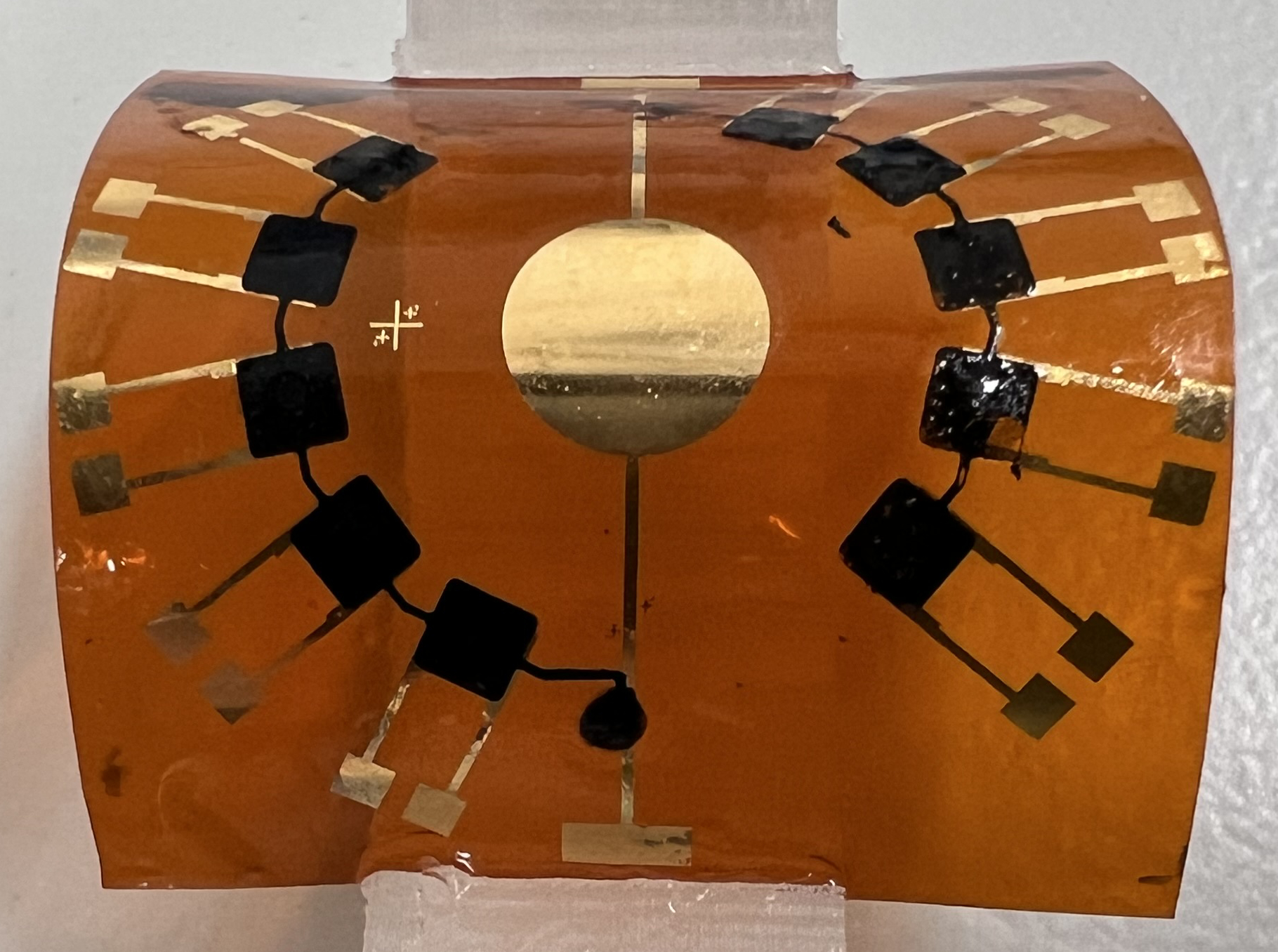
PEDOT_sGAGh (black) as sensor units on a flexible substrate

Europe needs stronger regulatory science for medical AI and MedTech
Researchers Advance Privacy-Preserving AI for Patient-Level Analysis of Surgical Videos