EKFZ Spin-Offs Secure Major Investments for AI-Based Cancer Diagnostics
Two EKFZ spin-offs, StratifAI and Cancilico, have successfully raised substantial investor funding to advance their AI-driven diagnostic technologies.
Read more
We are very proud that three of the eight awardees are affiliated with the EKFZ.
Congratulations to Dyke Ferber on receiving the Carl Gustav Carus Award for an outstanding scientific publication, and to Tina Gabriel and Xuan Peng for their exceptional dissertations.
Driving medical innovation, developing new therapies, and cultivating diagnostic techniques – on January 27, 2026, eight dedicated early-career researchers from the Carl Gustav Carus Faculty of Medicine of TU Dresden were awarded the prestigious Carl Gustav Carus Prize for their work. Three of the eight researchers are affiliated with the EKFZ for Digital Health.
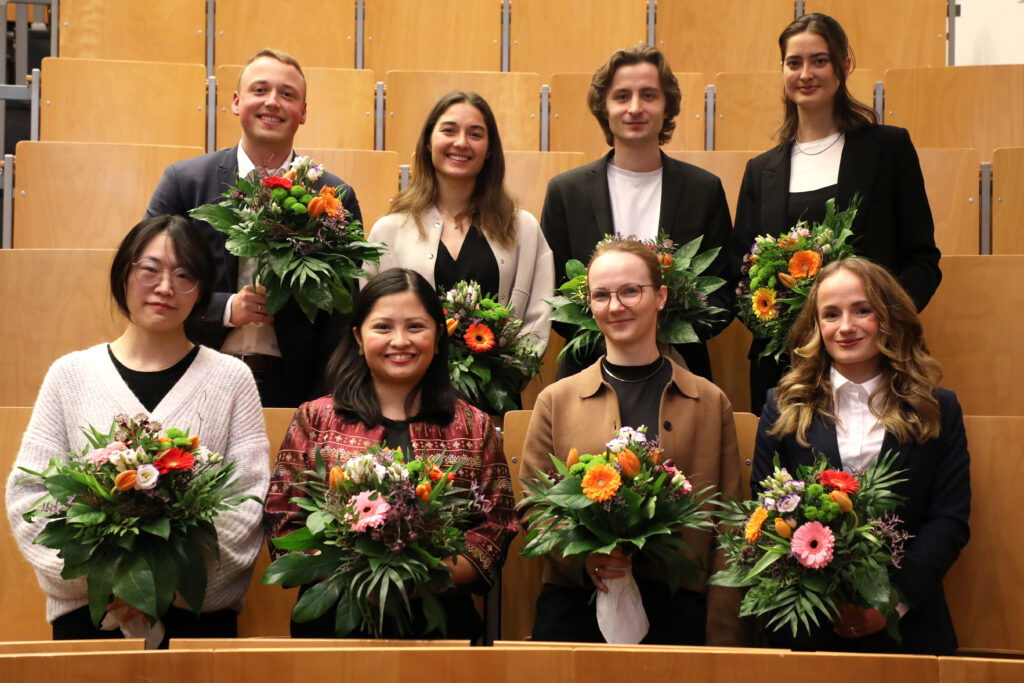
Award winners
upper row, from left to right: Jean-Paul Bereuter, Tina Gabriel, Dyke Ferber, Lina Lüttich | first row, from left to right: Xuan Peng, Anna Kristina Hernandez, Luise Rupp, Katrin Reichel
The Carl Gustav Carus Award has honored outstanding doctoral theses since 1998 and exceptional scientific publications since 2003. It is awarded to early-career researchers in medicine and health sciences who completed their doctoral degrees with summa cum laude or magna cum laude.
For her doctoral thesis in the field of clinical medicine, Tina Gabriel investigated how innovative ultrasound technology can contribute to the early and precise detection of diffuse liver diseases. By using H-scan imaging to analyze raw data from handheld ultrasound devices, she was able to show that this method enables practical differentiation of structural changes in liver tissue, thereby facilitating diagnosis, particularly in outpatient care. The work was supervised by Dr. Moritz Herzog and Prof. Jochen Hampe (both from the Else Kröner Fresenius Center for Digital Health).
Xuan Peng developed a microfluidic system for producing hydrogel droplets, which can be used to efficiently generate large numbers of 3D tumor cell models. This technology makes it possible to study tumor biology and therapeutic response under realistic conditions and to test new drugs more quickly. The supervisors were Prof. Larysa Baraban and Prof. Michael Bachmann (Else Kröner Fresenius Center for Digital Health/Helmholtz-Zentrum Dresden-Rossendorf).
This year’s publication award goes to Dyke Ferber for his publication “Development and validation of an autonomous artificial intelligence agent for clinical decision-making in oncology” in the journal Nature Cancer. Ferber developed and validated an autonomous AI agent that supports clinical decision-making in oncology. The study shows that the AI agent can evaluate complex medical data and provide therapy recommendations at the most advanced level. This is a significant step toward personalized, data-driven cancer medicine. The work was supervised by Prof. Jochen Hampe and Prof. Jakob N. Kather (Else Kröner Fresenius Center for Digital Health).
The breadth of topics and the depth of the work that our young researchers produce astounds us every year. Their dedication and their creativity are an invaluable asset to medical research and healthcare.
Our early-career researchers engage with pressing medical questions and make a vital contributions to new diagnostic and therapeutic concepts.
Excellent research deserves recognition and support. We are delighted that we were able to team up once again with Ostsächsische Sparkasse Dresden to honor innovative dissertations and scientific publications.
The award ceremony was held at the Dresden University Medicine campus with Representatives of the Foundation, the University Hospital, the Faculty of Medicine, and the Ostsächsische Sparkasse Dresden. Each award is endowed with up to EUR 1,000.
EKFZ Spin-Offs Secure Major Investments for AI-Based Cancer Diagnostics
Advancing Ultrasound Technologies

AI-generated synthetic data for cancer research and clinical trials