26 June 2026
Speaker invited by Prof. Jakob N. Kather

BCUBE | Center for Molecular Bioengineering | ground floor E73/74
Speaker invited by Prof. Jakob N. Kather
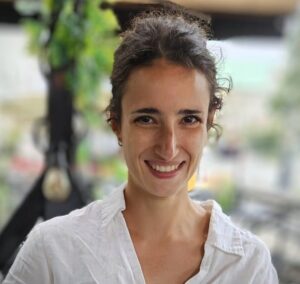
Dr.-Ing. Layla Riemann, M.Sc.
Institute for Applied Medical Informatics at University Medical Center Hamburg-Eppendorf (UKE)
The rapid growth of molecular and clinical data in oncology has shifted the central challenge of precision medicine from data generation to knowledge integration and clinical translation. Molecular Tumor Boards (MTBs), in particular, face the difficult task of navigating vast biomedical literature, heterogeneous patient data, and rapidly evolving therapeutic evidence.
In this talk, Dr. Riemann presents several complementary research initiatives aimed at building an ecosystem for Intelligent Oncology. A central component is the Knowledge Connector (KC), a clinical decision support system that structures evidence into Blocks of Clinical Knowledge (BoCKs), modular units linking biomarkers, molecular alterations, and clinical entities to treatment effects. To keep this knowledge base current, their research team developed AI pipelines using fine-tuned BERT models for automated literature prospecting, biomedical concept extraction, and evidence-level classification. Representing these data as a semantic knowledge graph enables advanced reasoning, including similarity discovery across tumor types and the identification of potential off-label treatments or clinical trials.
Beyond literature-based decision support, Dr. Riemann will highlight additional projects addressing key challenges in modern oncology. PreciOUS explores real-time monitoring of therapy-associated risks by integrating wearable-derived physiological signals with AI-based risk modeling. S.O.O.S. establishes a cross-institutional second-opinion network among German Comprehensive Cancer Centers through LLM-supported digitization and
harmonization of clinical documentation. Finally, we investigate synthetic patient data generation to enable privacy-preserving data sharing and AI development across institutions. Together, these approaches aim to connect heterogeneous data sources and create scalable AI tools that support clinicians and advance truly personalized cancer care.